Every cruise brochure and hotel concierge in Aruba will tell you the island is a jewelry bargain. Some of that is true. Some of it is marketing. If you are about to spend real money on a diamond, a gold chain, or a watch, you want the version without the sales pitch.
Here is the honest breakdown: what is genuinely cheaper in Aruba, what is not, where the good stores are, and how to make sure the piece you carry home is worth what you paid.
Is jewelry actually cheaper in Aruba?
Yes, often, but it depends heavily on what you buy. Aruba has no general sales tax or VAT the way most U.S. states and European countries do, and returning U.S. and Canadian residents get an $800 per-person duty-free exemption. On loose diamonds, gold, and pieces from independent jewelers, that can add up to real savings of roughly 10 to 30 percent versus home. On tightly price-controlled brands, the gap is much smaller.
The savings are real, but they are not automatic. A shopper who compares prices walks away ahead. A shopper who assumes every window is a deal usually does not.
Why jewelry costs less in Aruba
Three things drive the lower prices, and they matter in different amounts:
- No sales tax at the register. In the U.S., you might pay 6 to 10 percent in state and local sales tax on a jewelry purchase. Aruba does not charge that at the point of sale, so the sticker is closer to what you actually pay.
- The $800 U.S. duty exemption. When you fly home, each person can bring back $800 of goods duty-free. For most vacation jewelry purchases, that covers the whole piece with no import duty owed on re-entry.
- Direct sourcing. Many Aruba jewelers buy diamonds straight from cutting centers like Antwerp and commission settings from Italian workshops in places like Vicenza. Fewer hands in the supply chain mean a lower starting price on stones and gold.
Where you save the most (and where you don’t)
This is the part most guides skip. Savings are not equal across every category.
| What you’re buying | How much you typically save | Why |
|---|---|---|
| Loose diamonds | Highest | No sales tax, direct Antwerp sourcing, and the price is negotiable on the stone itself |
| Gold jewelry and chains | High | Priced closer to metal weight plus workmanship, with no sales tax added |
| Independent jeweler pieces | High | Local jewelers set their own margins and often negotiate |
| Colored gemstones | Moderate to high | Emeralds, sapphires, and tanzanite are priced well when sourced directly |
| Brand-controlled luxury (Cartier, Rolex, Louis Vuitton) | Low and inconsistent | These brands hold prices steady worldwide, so the only savings are the skipped sales tax |
The takeaway: if you came to Aruba to buy a diamond, a gold piece or something custom, you are shopping in the right place. If you came only for a specific Cartier or Rolex reference, check the exact price at home before you assume it is cheaper.
How Aruba’s “duty-free” and tax situation really works
You will see the phrase “duty-free” on almost every shop sign. It is worth understanding what it actually means, because the popular version is oversimplified.
Aruba does not have a general VAT or sales tax. What it does have is a turnover tax system (known locally as BBO/BAZV/BAVP) charged to businesses, which is usually built quietly into the shelf price rather than added at the register. So “zero tax” is not literally accurate, but the effect for a shopper is still a price with no visible sales tax stacked on top.
True bonded duty-free shopping, where goods carry no import duty at all, lives mainly at Queen Beatrix International Airport. In-town stores in Oranjestad and Palm Beach are better described as tax-friendly rather than strictly duty-free. Either way, the practical result for most visitors is the same: a lower out-the-door price than at home, especially once the $800 personal exemption is factored in.
What jewelry is Aruba known for?
Aruba’s jewelry scene splits into three lanes:
- Diamonds. The island’s calling card. GIA-certified stones, loose diamonds for investment, engagement rings and classic settings are what most serious buyers come for.
- Gold. Yellow, white, and rose gold in 14kt and 18kt, from simple chains to statement pieces, priced attractively thanks to direct sourcing and no register-added tax.
- Local and Caribbean-made pieces. Artisan jewelry using island themes, natural elements and sand-and-stone designs makes a meaningful keepsake you will not find in a mainland mall.
You will also find every major luxury house represented, from watches to designer collections, concentrated in the Oranjestad malls.
Where to shop: Aruba’s jewelry districts
Almost all of Aruba’s fine jewelry sits in two areas.
Oranjestad (downtown and the cruise-port area). This is the heart of jewelry shopping. Caya Grandi (Main Street), the Renaissance Mall, Royal Plaza Mall and the Renaissance Marketplace are all here, most within a short walk of the cruise terminal. The Renaissance Mall holds the luxury houses (Cartier, David Yurman, Rolex, Tiffany & Co. and more), while the surrounding streets are lined with independent jewelers.
Palm Beach (Noord). The high-rise resort strip has its own cluster, anchored by Paseo Herencia and Palm Beach Plaza, convenient if you are staying on that side of the island.
A few well-known names that shoppers compare on the island include Gandelman Jewelers (a downtown institution since 1969), Little Switzerland (multiple locations), Gold Palace Jewelers near the bus terminal, and Kay’s Fine Jewelry close to the cruise port.
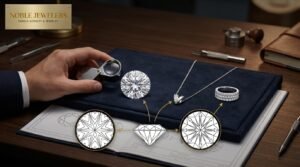
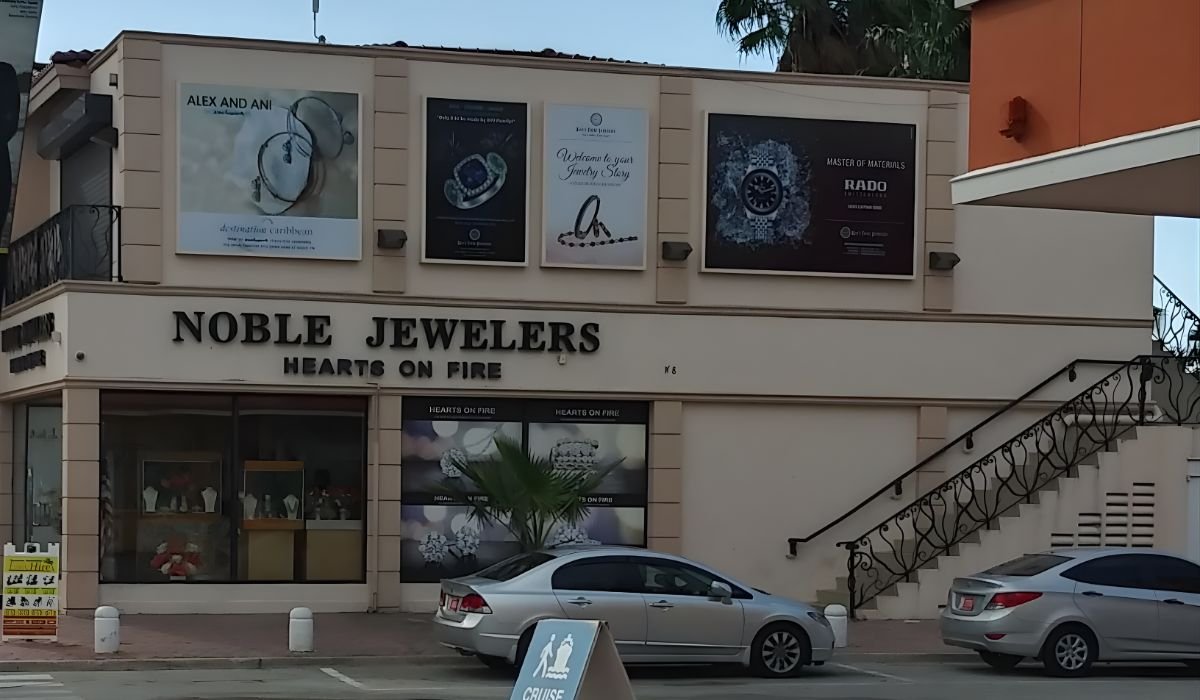
If you want a single recommendation to anchor your visit, Noble Jewelers on Weststraat, one block from the cruise terminal and directly across from Royal Plaza Mall, is the island’s only authorized Hearts On Fire dealer and the first to bring the world’s most precisely cut diamond to the Caribbean. Family-owned since 1994, they carry GIA-certified stones, loose diamonds up to 12 carats, and offer appraisals, repairs, and a no-pressure showing experience that has kept more than half their clients coming back year after year. It is an easy first stop for comparison shopping, whether or not you buy there.
5 things to check before you buy jewelry in Aruba
The difference between a smart purchase and an expensive mistake comes down to a few habits.
- Insist on certification. For any diamond of real value, ask for a GIA or IGI grading report. A certificate from the actual grading lab, not just an in-house card, is your proof of what you are buying.
- Get an independent appraisal. Reputable jewelers provide a detailed appraisal you can use for insurance back home. If a store hesitates, walk.
- Compare against the price at home. Pull up the same or a comparable piece online before you commit. This is the single fastest way to confirm the “deal” is real, especially on brand-name luxury.
- Confirm warranty, resizing, and aftercare. Ask what happens if the ring needs sizing or the setting loosens once you are home. Good jewelers stand behind the piece; some offer shipping and remote service.
- Be cautious with cruise-recommended lists. Some stores pay cruise lines to appear on “preferred” shopping guides, and those spots are not always the best value. Treat a recommendation as a starting point, not a guarantee, and always compare.
Is it safe to buy diamonds in Aruba?
For an established, certification-backed jeweler, yes. The safeguards you would use anywhere apply here: buy from a store with a physical reputation and history, require GIA or IGI certification on significant stones, take home a written appraisal, and keep your receipt for the $800 customs exemption. Aruba’s better jewelers deal in genuine, natural, responsibly sourced stones and will happily provide independent verification. The risk is not the island; it is skipping the paperwork.
The bottom line
Aruba earns its reputation as a jewelry destination, with two honest caveats. The savings are real on diamonds, gold, and independent pieces, and thin on globally price-fixed luxury brands. And the deal only holds if you certify, appraise, and compare. Do those three things, and you leave with a genuine piece at a genuine value, plus a story that beats anything bought in a mall back home.
If a diamond is on your list, start where the certification and the track record are strongest. Book a virtual appointment with Noble Jewelers before your trip, or stop in on Weststraat once you are on the island, and see the difference a properly cut, GIA-verified stone actually makes.
FAQs
Is jewelry cheaper in Aruba than in the US?
Often yes, mainly on diamonds, gold and independent pieces, thanks to no sales tax and direct sourcing. Brand-name luxury savings are small.
Is gold cheaper in Aruba?
Yes, gold is generally cheaper because it is priced near metal weight and workmanship with no sales tax added.
Are diamonds cheaper in Aruba?
Loose diamonds are among the best values on the island, priced without sales tax and often sourced directly from Antwerp cutting centers.
Do you pay duty on jewelry bought in Aruba?
U.S. and Canadian residents get an $800 per-person duty-free exemption, which covers most vacation jewelry purchases with no duty owed.
Is buying jewelry in Aruba safe?
Yes, when you buy from an established jeweler, require GIA or IGI certification, and take home a written appraisal for insurance.
Where is the best jewelry shopping in Aruba?
Downtown Oranjestad near the cruise port has the highest concentration, including the Renaissance Mall luxury boutiques and independent jewelers.
What jewelry is Aruba known for?
Certified diamonds, gold, colored gemstones, and Caribbean-made artisan pieces, along with major luxury watch and jewelry brands.
Should I buy jewelry from cruise-recommended stores in Aruba?
Use them as a starting point only. Some pay for placement, so always compare prices and certification before you buy.