Most people, when buying jewelry in Aruba, get surprised twice. First at the register, when the number on the tag is the number they pay. Then at the airport, when the customs officer barely looks up. Neither one is luck. Both come down to how Aruba prices jewelry and how the United States treats travelers coming home. Once you understand both, you stop guessing and start planning.
In simple words, Aruba builds its tax into the shelf price, so the tag price is what you pay, with nothing added at checkout. When you land back in the US, you get a personal duty exemption on goods you bring home, and most vacation jewelry falls inside it. Confirm the current exemption and rate with US Customs and Border Protection before you travel, since these figures change.
What You Actually Pay At The Counter
In much of the United States, the price on a jewelry tag is not the final price. Sales tax gets added at checkout, and depending on your state, that can add real money to an already large purchase.
Aruba does not run a sales tax or a VAT system the way the US or Europe does. It runs a turnover tax on businesses, a combined rate of about 7 percent. Since 2019, Aruban law has not allowed that tax to appear as its own line on your invoice. So the store folds it into the price you see on the tag.
This matters because it explains something people get wrong. Aruba is not tax-free. The Aruba jewelry tax structure exists; it just sits inside the number instead of stacking on top of it. When a piece is marked at a given price, that is the full price. No math at the counter, no second charge waiting for you at the end.
Why The Underlying Prices Often Run Lower
The jewelry tax structure explains your checkout experience. It does not fully explain why a comparable stone often costs less here than it would at a mall back home. A few real reasons drive that.
Established Aruba jewelry stores buy loose diamonds directly from cutting centers and commission settings from workshops abroad, cutting out layers between the stone and the case. Oranjestad also packs an unusual number of jewelers into a small strip, all competing for the same visitors, which keeps prices honest. Operating costs on the island tend to run lower than an equivalent mainland retail spot too.
None of this means every piece here is a bargain. Globally price-controlled luxury brands cost close to the same everywhere, since their pricing is set centrally. Where the island genuinely wins is on diamonds, gold, and independent designer work. Knowing that before you shop tells you where to spend your time.
What Happens At Home After Buying Jewelry in Aruba
This is the part where most people get vague advice on duty-free jewelry in Aruba, so here is the shape of it.
US residents returning from abroad get a personal duty exemption on goods they bring back. Most vacation jewelry purchases fall inside that exemption, and travelers going home together can often combine their individual allowances on one declaration. That matters if you and a partner bought a piece together.
Spend above the exemption and duty applies to the amount over it, usually at a modest rate rather than a steep one. Confirm the current exemption amount and rate on the CBP website before your trip, since these figures do shift over time and a jeweler quoting last year’s number does you no favors.
Two things matter more than any number. After declaring jewelry to US customs, the process is routine, and the exemption is generous. Underdeclaring a real purchase to dodge a small duty is the one reliable way to turn an easy trip into a real problem. And keep your paperwork. Your itemized invoice, plus a grading certificate if the piece has one, turns your declaration into a thirty-second conversation instead of a long one.
What To Walk Out With, Besides The Piece
So the answer to is jewelry cheaper in Aruba is it depends. A purchase that travels well comes with a paper trail. Ask for all of it before you leave the counter.
Get an itemized invoice with the store’s full details on it. Ask for the independent grading certificate on any diamond of real size, and ask whether it is GIA before you buy, not after. Get a written description of the metal, carat weight, and setting, since this is exactly what your insurer will want later. Take a few photos of the piece in normal light before you pack it.
If a store hesitates to hand any of this over, that tells you more than a price comparison ever could.
Before You Land
The smart way when buying jewelry in Aruba starts before your flight, not on the street. Browse designer jewelry, loose diamonds, and Dune Jewelry’s sand-set pieces online first, so you land with a rough shape, metal, and scale already in mind. Then spend your island time on the part that only happens in person, seeing stones side by side under real light with someone who can explain what you’re looking at.
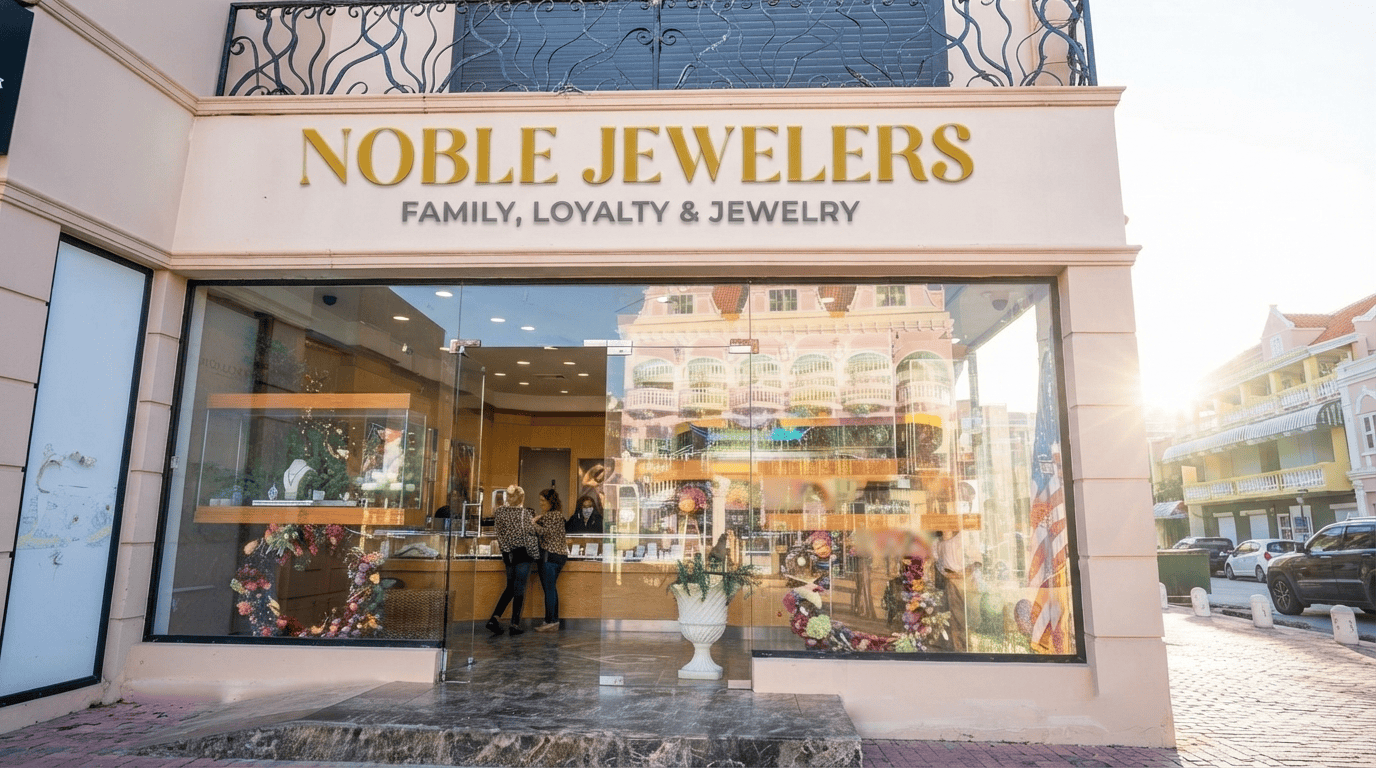
Noble Jewelers Aruba has done exactly that from the Weststraat store since 1994, and more than half the people who walk in have been in before. We’re an authorized Hearts On Fire jeweler, the first in the Caribbean, and an authorized retailer for Dune Jewelry and JAI, so you’re choosing from pieces with real provenance, not just a nice display case.
If you’d rather have time set aside than fight a crowded counter, book an appointment before you arrive, or message us on WhatsApp and we’ll have pieces pulled and ready.
Frequently Asked Questions
Is Aruba really tax-free for jewelry?
No. Aruba charges a turnover tax, but the law bans showing it as a separate line on your receipt. It sits inside the tag price, so you never see it added at checkout.
Is jewelry cheaper in Aruba than at home?
Often, for diamonds, gold, and independent designer pieces. Globally price-controlled luxury brands cost about the same anywhere, since their prices are set centrally.
Do I have to declare jewelry bought in Aruba at US customs?
Yes. Declare it on your way back in. Most vacation purchases fall inside your personal exemption, so declaring usually costs you nothing but a moment at the desk.
What should I ask my jeweler for before I fly home?
An itemized invoice, a grading certificate for any significant diamond, and a written description of the metal and carat weight for insurance.